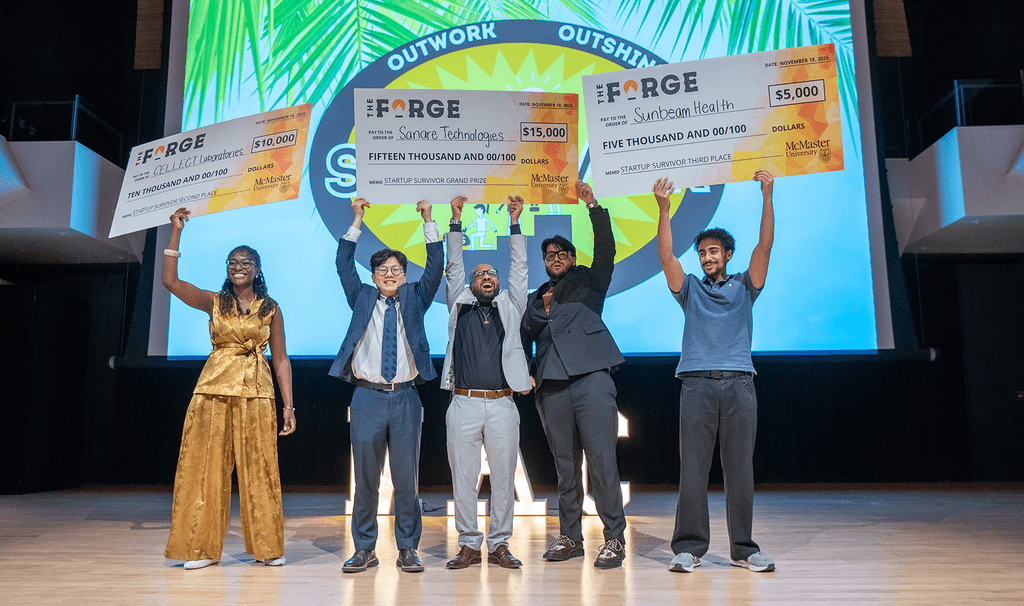
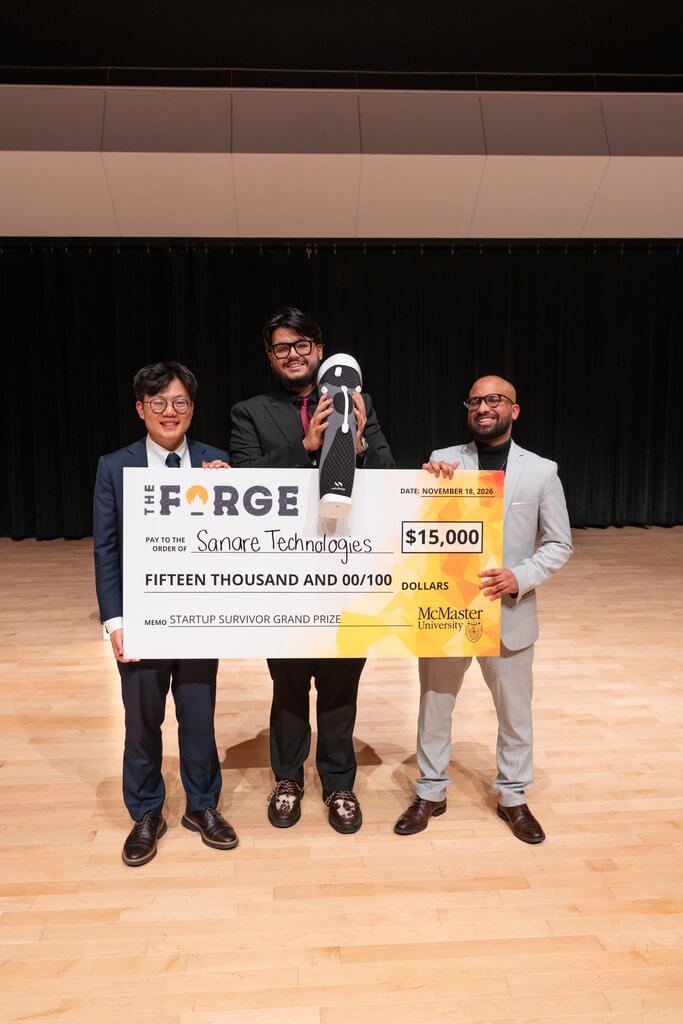
A company created by McMaster students who are filling a critical gap in the injury recovery process has been crowned the winner of this year’s Startup Survivor.
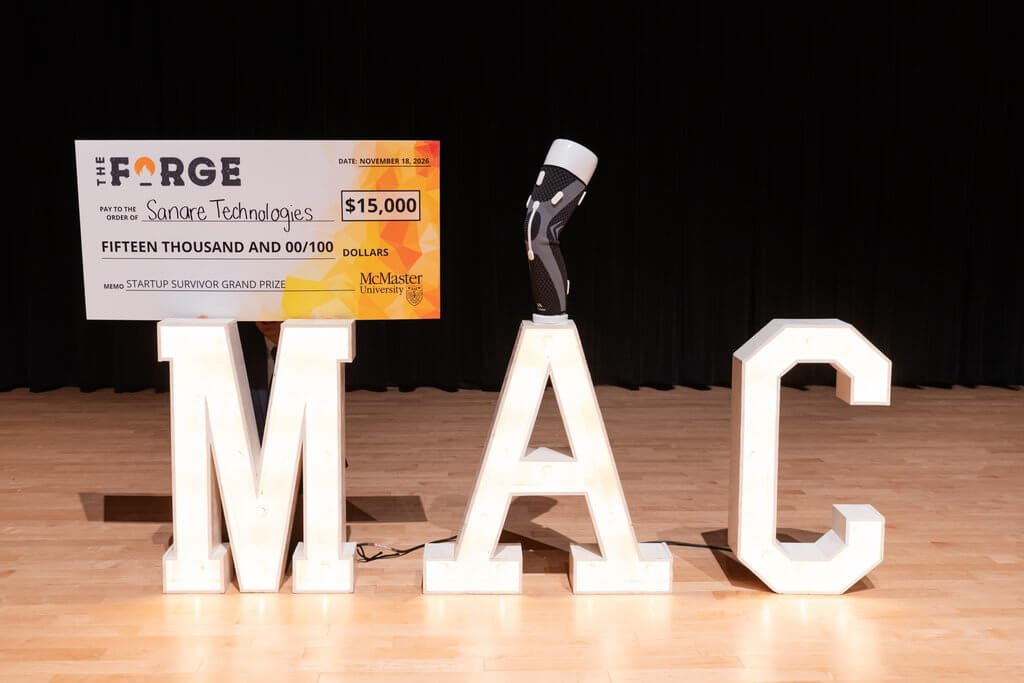
Sanaré Technologies took first place and $15,000 at the Forge’s annual pitch competition for a patent-pending flexible knee sleeve fitted with sensors that measure muscle movement during ACL recovery.
Right now, clinicians can only get data on an injury once or twice a year, if the patient is able to get to a specialized facility. This has substantial consequences for patient recovery, said Manu Dissanayake, co-founder of Sanaré and a Master of Biomedical Innovation grad at McMaster.
“It’s why one in three young patients are suffering from ACL re-tears, lifelong complications, and it’s costing the health-care system $7 billion in preventable damage,” Dissanayake said during his winning pitch this week.
The Sanaré knee sleeve is a sleek, wearable alternative to the bulky, expensive machinery patients would be fitted with at a clinic. It has with flexible electrodes made of silicon that move with the leg muscles and transmit personalized data directly to a dashboard, enabling clinicians to monitor progress and customize recovery plans.
“This is going to change rehabilitation because now deficits can be identified and acted upon in the first six months,” said Dissanayake. “Exercise plans can be personalized to a patient’s weak spots and their individual sport. And returning to sport decisions will be based on continuous longitudinal data.”
The $15,000 prize is going to help Sanaré miniaturize sensors for their functional prototype sleeve and begin to distribute their product to clinicians to begin collecting data to inform their pre-submission to the FDA.
Sanaré was one of five finalists from a program of 20 startups that participated in the four-month accelerator program from the Forge, with the top three pitches winning a total of $30,000 to move their innovations from lab to market.
The second-place prize of $10,000 went to CELLECT Technologies, a women’s health startup from Ibukun Elebute and CT Murphy, two Master of Business, Entrepreneurship and Technology graduates from the University of Waterloo. Their startup aims to make menstrual fluid easier to collect, process, and use for women’s health research and diagnostics.
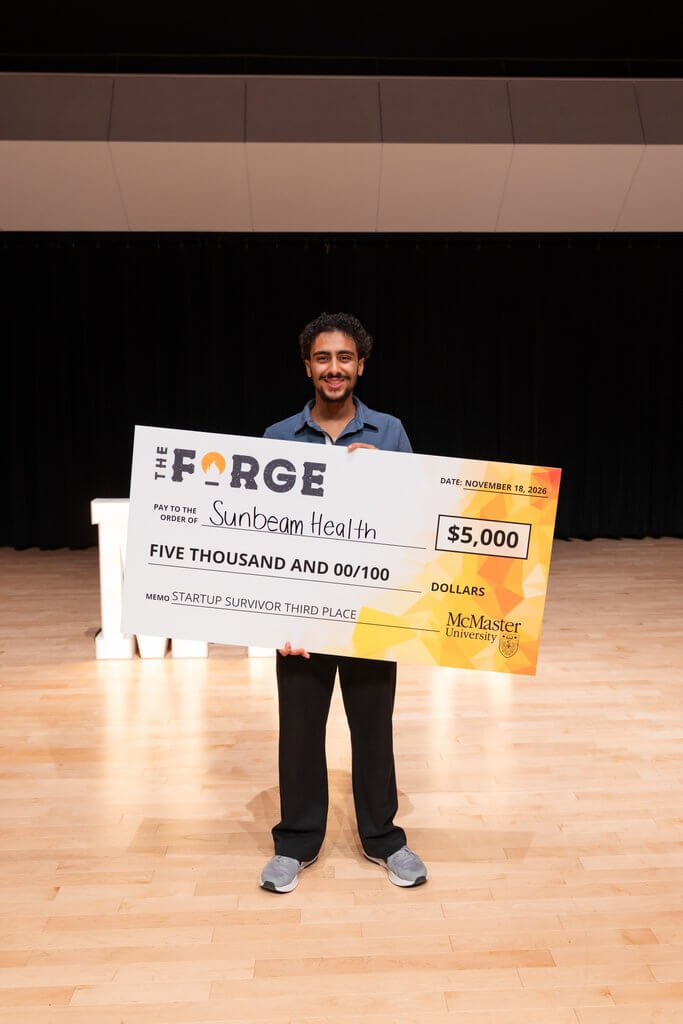
Third place and $5,000 was awarded to Sunbeam Health, a clinical intake and documentation platform to make it easier for clinicians to diagnose adults with ADHD, created by McMaster Biochemistry undergraduate student David George.

This year’s cohort of Startup Survivor, which provides budding entrepreneurs with mentorship and rigorous challenges to refine and strengthen their innovation ventures, was bolstered with $300,000 in funding from Intellectual Property Ontario (IPON) through the Innovation Fellowship Program.
That funding helped double the number of participants in the program, as well as each team’s allocated funding over the summer leading up to the pitch competition.
“Throughout the program, we challenged teams with tough business and technical milestones, pushed them outside their comfort zones, and supported them as they grew as founders,” said Mariya Leslie, manager of student entrepreneurship for the Forge.
No matter the outcome of the competition, Leslie said the resilience and dedication of every single team has been inspiring.
“Your future is bright, and the Forge and McMaster University will continue to support you as you grow your ventures.”
Immediately after Dissanayake and his Sanaré co-founders were crowned the Startup Survivor champions, the trio were approached by audience members who were eager to participate in clinical trials for their product, citing a real need for their technology.
That interaction felt “amazing”, said Dissanayake, and reinforces the power of Startup Survivor to make a real-world impact.
Meet the 2026 Startup Survivor winners and finalists
Sanaré Technologies | Pitched by Manu Dissanayake, co-founder and CEO, Master of Biomedical Innovation, Faculty of Health Sciences, McMaster University
Co-founders: Jialiang (Kevin) Hu, CTO, Master of Biomedical Innovation, Faculty of Health Sciences, McMaster University; Sarim Shiraz, COO, Master of Biomedical Innovation, Faculty of Health Sciences, McMaster University
Sanaré Technologies’ wearable Sanaré Sleeve combines a range of motion tracking and muscle activation data to give clinicians real-time insight into patient recovery between visits. By improving remote monitoring and patient engagement, Sanaré enables more personalized rehab, safer return to activity decisions, and better outcomes.
CELLECT Laboratories | Pitched by Ibukun Elebute, co-founder, Master of Business, Entrepreneurship and Technology, Faculty of Engineering, University of Waterloo
Co-founder: CT Murphy, Master of Business, Entrepreneurship and Technology, Faculty of Engineering, University of Waterloo
CELLECT Laboratories is a women’s health technology company building the collection infrastructure that makes menstrual fluid easier to collect, process, and use for research and diagnostics.
Despite containing valuable biological information, menstrual fluid remains largely underutilized due to challenges with collection and laboratory processing. CELLECT is developing a proprietary, no-insertion platform that collects menstrual and vaginal fluid externally, then separates and stabilizes the sample for laboratory testing. By making menstrual fluid a practical, lab-compatible diagnostic sample that integrates with existing laboratory infrastructure, CELLECT is creating a scalable pathway for HPV, STIs, and broader gynecological diagnostics.
Sunbeam Health | Pitched by David George, founder and CEO, Honours Bachelor of Biochemistry student, Faculty of Science, McMaster University
Sunbeam Health is an AI platform that will help family doctors diagnose ADHD instead of referring patients to specialists with month-long waitlists. Through voice-based patient intake, validated screening tools, and ready-to-use clinical documentation, physicians can complete an assessment within a standard doctor’s visit. The platform is free for family physicians and is supported by Harvard’s Health Systems Innovation Lab.
On top of the $5,000 award through Startup Survivor, Sunbeam Health has received $5,000 in funding from the Sam and Roma Mercanti Foundation in recognition of its innovative approach to improving patient care and streamlining health-care processes.
Sunbeam was also selected by Harvard’s Health Systems Innovation Lab as one of 50 startups from over 14,700 applicants worldwide and won first place in the Forge’s summer incubator. A clinical study with a major Canadian university is now being set up.
Sensera Health | Pitched by Elsa Sheikh, co-founder of Sensera, Master of Biomedical Innovation, Faculty of Health Sciences, McMaster University
Co-founders: Kristen Kwok, Masters of Biomedical Innovation, Faculty of Health Sciences, McMaster University; Megan Di Muzio, Masters of Biomedical Innovation, Faculty of Health Sciences, McMaster University; Finnoula O’Neill-King, Master of Biomedical Innovation, Faculty of Health Sciences, McMaster University
Sensera Health is a biomedical innovation company that is developing an innovative hydration monitoring device for high-risk patients that helps clinicians detect issues earlier, intervene sooner, and improve patient outcomes.
Created in close collaboration with frontline health-care providers, Sensera’s solution pairs a wearable patch with a real-time dashboard to deliver continuous, 24/7 hydration measurements. By replacing sporadic, manual checks with proactive, trend-based risk alerts, Sensera Health empowers overstretched care teams to catch dehydration early and prevent costly complications before clinical decline begins.
AeroVasQ | Pitched by Turki Alturaifi, co-founder and clinical/scientific lead, Masters of Biomedical Innovation and advanced aortic fellow, Faculty of Health Sciences, McMaster University;
Co-founders: Mahip Raj KC, Masters of Biomedical Innovation, Faculty of Health Sciences, McMaster University; Angela Ning Yan, Master of Biomedical Innovation, Faculty of Health Sciences, McMaster University
AeroVasQ is developing a sterile, easy-to-use technology designed to remove air from endovascular devices like stents before they’re introduced into patients.
Air trapped in endovascular device delivery systems can enter the bloodstream and cause serious complications, including stroke, and AeroVasQ’s solution is intended to fit seamlessly into existing clinical workflows without interrupting procedures.
Interested in launching your own business venture? Applications will open in January for next year’s Startup Survivor. Click here to learn more.