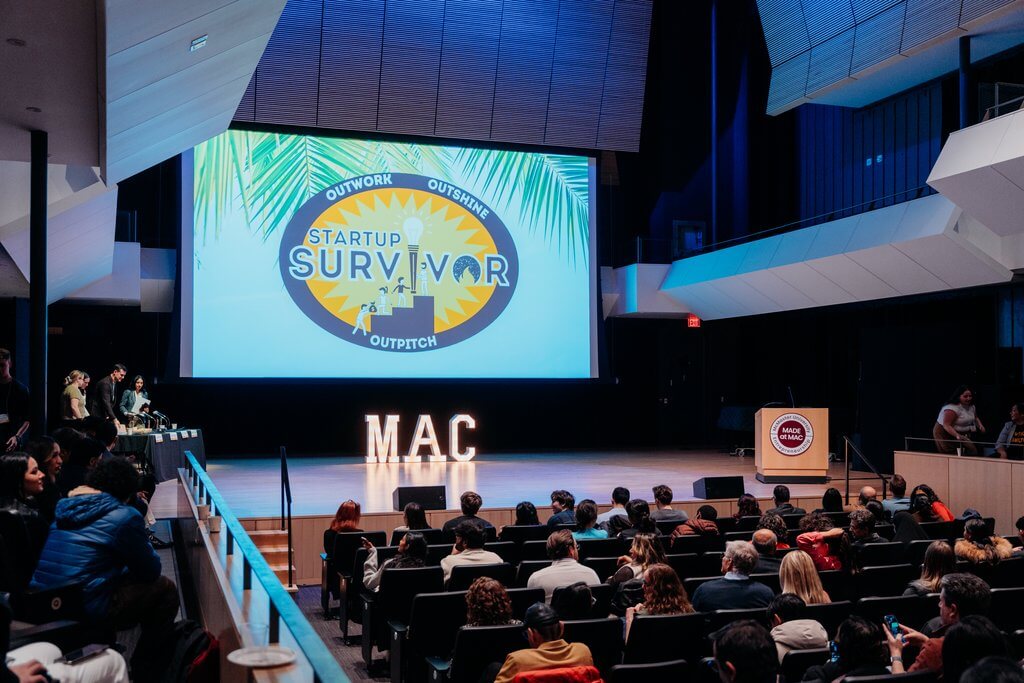
A new round of student-led startups will take the stage this November as finalists in The Forge’s Startup Survivor Pitch Competition.
After a summer of building, testing, and refining their innovations, these five startups are ready to pitch their ventures and compete for a share of $30,000 in prize funding, powered by The Forge, McMaster University’s startup incubator.
This year, McMaster University received $300,000 in funding from Intellectual Property Ontario (IPON) through the Innovation Fellowship Program to expand Startup Survivor.
Funding and support from IPON has expanded access to IP education and mentorship for students in the program, while also doubling the number of participating startups from 10 to 20 teams. Funding has also increased from $5,000 to $10,000 per team over their summer placement, making this the program’s most competitive Pitch Competition yet.
Preparing their pitches
Startup Survivor is more than a competition. It is the culmination of a summer of hard work, experimentation, and determination as student founders transform ideas into impactful ventures.
Throughout the summer, participants completed five business and technical challenges which focus on business modeling, prototyping, intellectual property, go-to-market strategy, and pitching to investors.
“What makes Startup Survivor unique is its challenge-based structure, which encourages founders to move quickly and de-risk their startups by achieving critical early-stage milestones,” says Mariya Leslie, Manager of Student Entrepreneurship at The Forge.
“I’ve been incredibly impressed by how hard these student founders worked throughout the summer. In just a few months, they made remarkable progress, from prototyping to refining their business models and securing early traction.”
As part of Startup Survivor’s expanded support network, selected teams also had access to mentorship opportunities through The Clinic, McMaster’s health innovation hub within the DeGroote Heersink Hub. The Clinic supports the development of health innovators and entrepreneurs across the university ecosystem.
This November, the top five startups will take the stage to showcase their progress and compete for first-place at the Startup Survivor Pitch Competition.
Sunbeam Health
Founded by David George, an Honours Biochemistry student, Sunbeam Health helps family doctors diagnose ADHD instead of referring patients to specialists with month-long waitlists. Sunbeam Health is an AI platform that conducts voice-based patient intake, applies validated screening tools, and generates ready-to-use clinical documentation so physicians can complete an assessment within a standard doctor’s visit. The platform is free for family physicians and is supported by Harvard’s Health Systems Innovation Lab.
In addition to being named a Startup Survivor finalist, Sunbeam Health has received $5,000 in funding from the Sam and Roma Mercanti Foundation in recognition of its innovative approach to improving patient care and streamlining healthcare processes.
David plans to use the additional funding to support partnership development with healthcare organizations, researchers, and industry stakeholders.
“These relationships will help accelerate clinical validation, expand access to pilot opportunities, and position Sunbeam Health for long-term impact and growth,” said David.
AeroVasQ
AeroVasQ standardizes air removal from endovascular devices before entering patients. This team includes Dr. Turki Alturaifi, Angela Ning Yan, and Mahip Raj KC, who are all pursuing a Masters of Biomedical Innovation at McMaster University. AeroVasQ’s technology will help reduce the risk of air bubble-related stroke, an issue that has validated unmet need with prominent surgeons from the US and Canada.
CELLECT Laboratories Inc.
CELLECT Laboratories Inc., founded by Ibukun Elebute and CT Murphy, is developing a proprietary, no-insertion platform that collects menstrual and vaginal fluid externally, then separates and stabilizes the sample for laboratory testing. By making menstrual fluid a practical, lab-compatible diagnostic sample that integrates with existing laboratory infrastructure, CELLECT is creating a scalable pathway for HPV, STI, and broader gynecological diagnostics.
Sanaré Technologies
Sanaré Technologies is redefining musculoskeletal rehabilitation through continuous, data-driven care with its wearable remote monitoring sleeve. This team includes Manu Dissanayake, Jialiang (Kevin) Hu, and Sarim Shiraz, who are all pursuing a Master of Biomedical Innovation at McMaster University. Sanaré Technologies has begun early research collaborations with leading Canadian and US academic centers.
Sensera Health
The final startup is Sensera Health, which is developing an innovative hydration monitoring device for high-risk patients that helps clinicians detect issues earlier, intervene sooner, and improve patient outcomes. Sensera’s co-founders Elsa Sheikh, Finnoula O’Neill-King, Kristen Kwok, and Megan Di Muzio are all students at McMaster University’s Master of Biomedical Innovation program. The team has already built a strong network of clinical and industry connections that will help support its growth beyond Startup Survivor.
Join the action
Join us Wednesday, November 18th, 2026, from 5-8pm as these five startups pitch their hearts out in front of a live audience and a panel of expert judges. After deliberation from the judges, three startups will be crowned and receive a prize of either $15,000, $10,000, or $5,000. The competition provides an opportunity for each team to showcase its progress, build valuable connections, and take the next step toward commercialization.
Whether you’re a founder, investor, student, or startup enthusiast, this is your chance to see the next generation of McMaster innovators in action. Come cheer on the finalists, network with innovators, and witness the next wave of McMaster-born startups.
Acknowledgements
Startup Survivor would not be possible without the support of the organizations and individuals who are committed to advancing student entrepreneurship. We extend our sincere thanks to McMaster University, the McMaster Faculty of Engineering, Intellectual Property Ontario (IPON), and the Sam and Roma Mercanti Foundation for their investment in the next generation of innovators.
We also gratefully acknowledge Alexandra Yhip (DeGroote Heersink Hub) and Daryl Sherman (McMaster Mentorship Network) for their mentorship and guidance throughout the program, as well as the many mentors, advisors, judges, and community partners who generously shared their time and expertise to help participants strengthen their ventures and accelerate their entrepreneurial journeys.