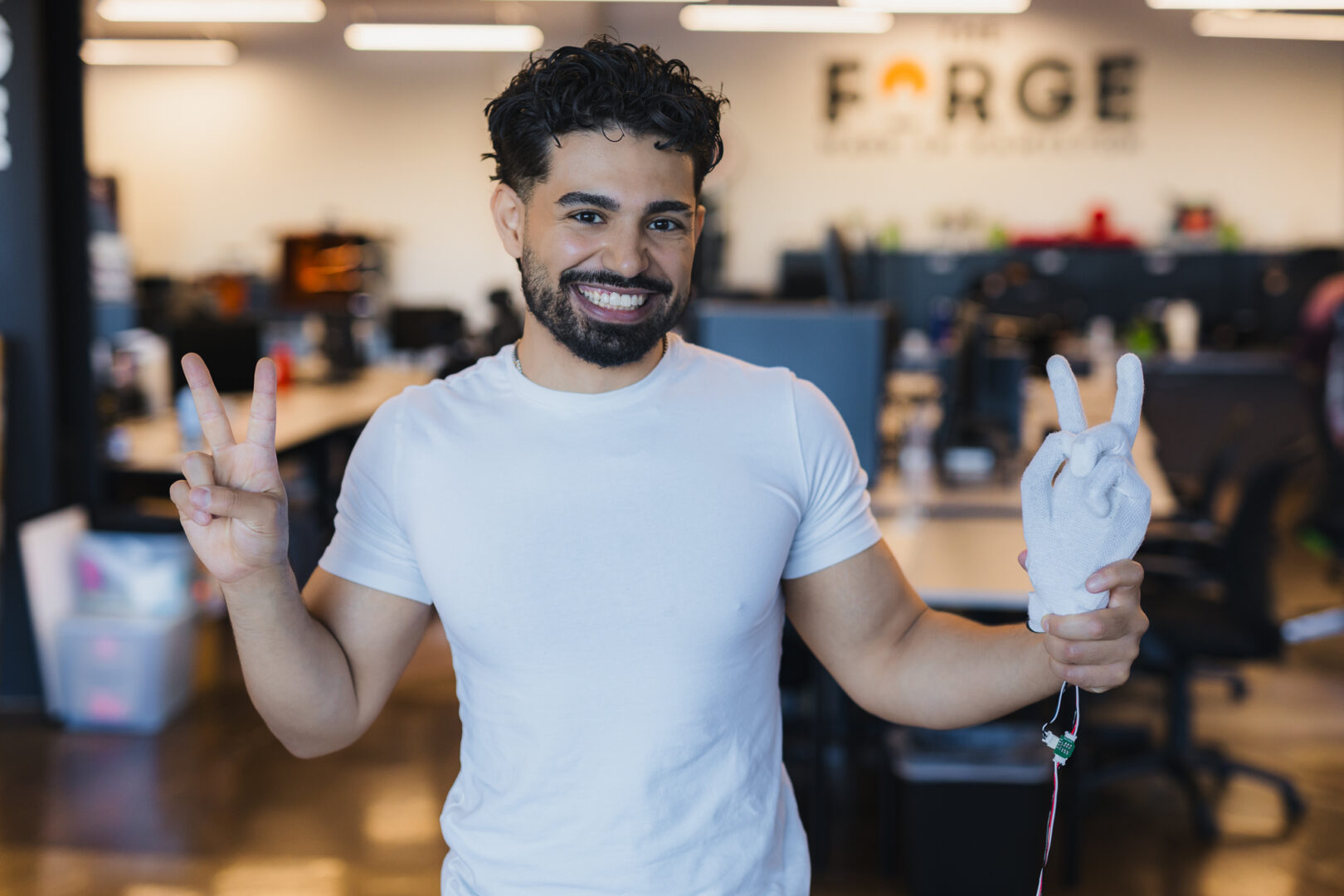
When Ahmed Ibrahim was just 10-years-old and living in Syria, he attempted to build an artificial hand, cobbling it together with Lego blocks and tiny motors salvaged from a remote-control toy helicopter he dismantled for parts.
“My best friend lost his hand during a bombing and I wanted to help him,” recalls Ibrahim, who lived in Syria amid escalating violence before coming to Canada with his family as a teenager.
With no Internet access in Syria, Ibrahim turned to old National Geographic magazines for inspiration on how to build a new hand for his friend.
“Not surprisingly, my project failed miserably and my friend was stuck with a prosthetic hook,” recalls Ibrahim, now 25. But the project captured Ibrahim’s imagination, and he remained deeply interested in creating high-tech prosthetics. This fascination went on to shape his education and career.
“My mission is to tackle one of the biggest challenges in robotics: creating a robotic hand that can move and adapt like a human hand.” — Ahmed Ibrahim, innovator
Launching a start-up
Three years ago, Ibrahim launched Better Bionics, an award-winning start-up company that aims to transform prosthetics through artificial intelligence (AI) and 3D printing.
“My mission is to tackle one of the biggest challenges in robotics: creating a robotic hand that can move and adapt like a human hand,” says Ibrahim, who recently received a DRIVE SPARK Funding Grant from Hamilton Health Sciences (HHS) to support further development of this innovation.
“We’re pleased to include the next generation of innovators among this year’s DRIVE SPARK winners, and support projects with real potential to improve health care locally and globally.” — Dr. Marc Jeschke, HHS vice president, research and innovation
HHS DRIVE SPARK awards celebrate early-stage, high-potential ideas that are igniting change across the hospital system with grants up to $50,000 to support bringing promising innovations to life.

Left to right: Dr. Gianni Parise, McMaster University’s vice president of research; Dr. Marc Jeschke, HHS vice president of research and innovation, and chief scientific officer; Dr. John Kelton, executive director of McMaster’s DeGroote Heersink Hub; Ahmed Ibrahim, DRIVE SPARK award winner; and Tracey MacArthur, HHS president and CEO.
A niche innovation
People missing a hand can currently choose from a range of prosthetics, from a simple hook to sophisticated models that use signals from the user’s muscles. Ibrahim’s goal is to create a highly realistic robotic hand with more functionality than anything else on the market.
His prototype uses sensors and AI to interpret signals from the user’s muscles to help control the hand’s movements and learn from those movements.
“The device’s multiple tiny motors, sensors and machine learning allow for 20 different movements, giving the fingers and thumb greater independence and allowing the hand to make more complex, natural movements,” says Ibrahim.
“It’s designed to learn how a person’s muscles and nerves signal movement, gradually adapting to the individual user. It literally begins to read your thoughts about movement over time, and then teaches itself how to read the wearer’s thoughts, becoming like part of the body.”

Two prototypes of a high-tech prosthetic hand being developed by Ibrahim, and Better Bionics
Supporting young innovators
“Health innovation starts with seeing a problem and believing there’s a better way to provide patient care,” says Dr. Marc Jeschke, HHS’ vice president of research and innovation, and chief scientific officer. “We’re pleased to include the next generation of innovators among this year’s DRIVE SPARK winners, and support projects with real potential to improve health care locally and globally.”
Ibrahim is developing this high-tech robotic hand with feedback and support from experts at HHS’ prosthetics & orthotics rehabilitative care department, located at our Ron Joyce Children’s Health Centre (RJCHC).
“It’s a very unique product that could stand out in the marketplace because of its functionality, scalability, size and potentially its cost.”— Brad Haardeng, HHS’ prosthetics and orthotics
This prosthetics and orthotics lab is the largest in Canada, serving children and adults from across the country. Services include customized prosthetic and orthotic devices, as well as the expansion of in-house 3D printing devices. Ibrahim’s device was created for adults but can be reduced in size to fit a child as young as 12.
Partnering with HHS
About one year ago, Ibrahim reached out to Brad Haardeng, clinical manager for HHS’ prosthetics and orthotics, for feedback on his prototype. Haardeng — a certified prosthetist-orthotist who’s trained to design, make and fit prosthetics – recommended modifications to the palm to make it more functional and look more lifelike. Since then, Ibrahim has also received feedback from amputee rehab physiatrists, Drs. Celina Lin and Sharon Grad along with other HHS team members. The department is also assisting with generating some prototypes on its 3D printer.
Ibrahim is also collaborating with HHS to develop a protocol, or detailed plan, for clinical evaluation and testing with patients. Next steps include submitting the completed protocol to the Hamilton Integrated Research Ethics Board (HiREB), which reviews research involving patient participants to ensure it’s safe, ethical and scientifically sound.
The goal is to launch a study at the prosthetics and orthotics lab, where patients test the hand for such things as comfort and functionality, while team members evaluate this testing.
“It’s a very unique product that could stand out in the marketplace because of its functionality, scalability, size and potentially its cost,” says Haardeng.
Ibrahim’s goals include making it affordable to patients through existing programs that help pay for prosthetic devices.

The robotic hand includes tiny, custom-made components
Passion for helping others
Living through conflict as a child fueled Ibrahim’s passion for helping people who experienced limb loss.
“These kinds of environments can be the biggest driving force and motivator for helping people through new innovations, because you see the hardships they’re going through,” he says, adding, “It really pushed me to find a way to help people and change the world for the better.”
As a teenager at Glendale Secondary School in east Hamilton, Ibrahim started a robotics club, entering his latest prosthetic-hand prototypes at science fairs. At McMaster University, while working on a master’s degree in neuroscience and biomedicine, he connected with networks that support local innovators including McMaster’s The Forge, The Clinic as well as The Innovation Factory.
Building back self-esteem
For many people, having a highly realistic prosthetic hand is about more than function. Being able to use their hand more naturally, perform everyday tasks independently and feel more comfortable in social situations can also boost confidence and self-esteem. To help make the hand look realistic, flesh-tone cover could be incorporated.
“When you lose part of your body, you can lose your sense of self,” says Ibrahim, who remembers his childhood friend becoming self-conscious and hiding his prosthetic hook behind his back. It affected his quality of life in other ways, too. “My friend loved soccer, and was our team’s goaltender, but stopped playing after he lost his land.”
Ibrahim’s childhood friend is still in Syria. The two have little contact now, largely due to distance and the political climate.
“But it would be nice if one day he could try the Better Bionics hand that he inspired so many years ago,” says Ibrahim.