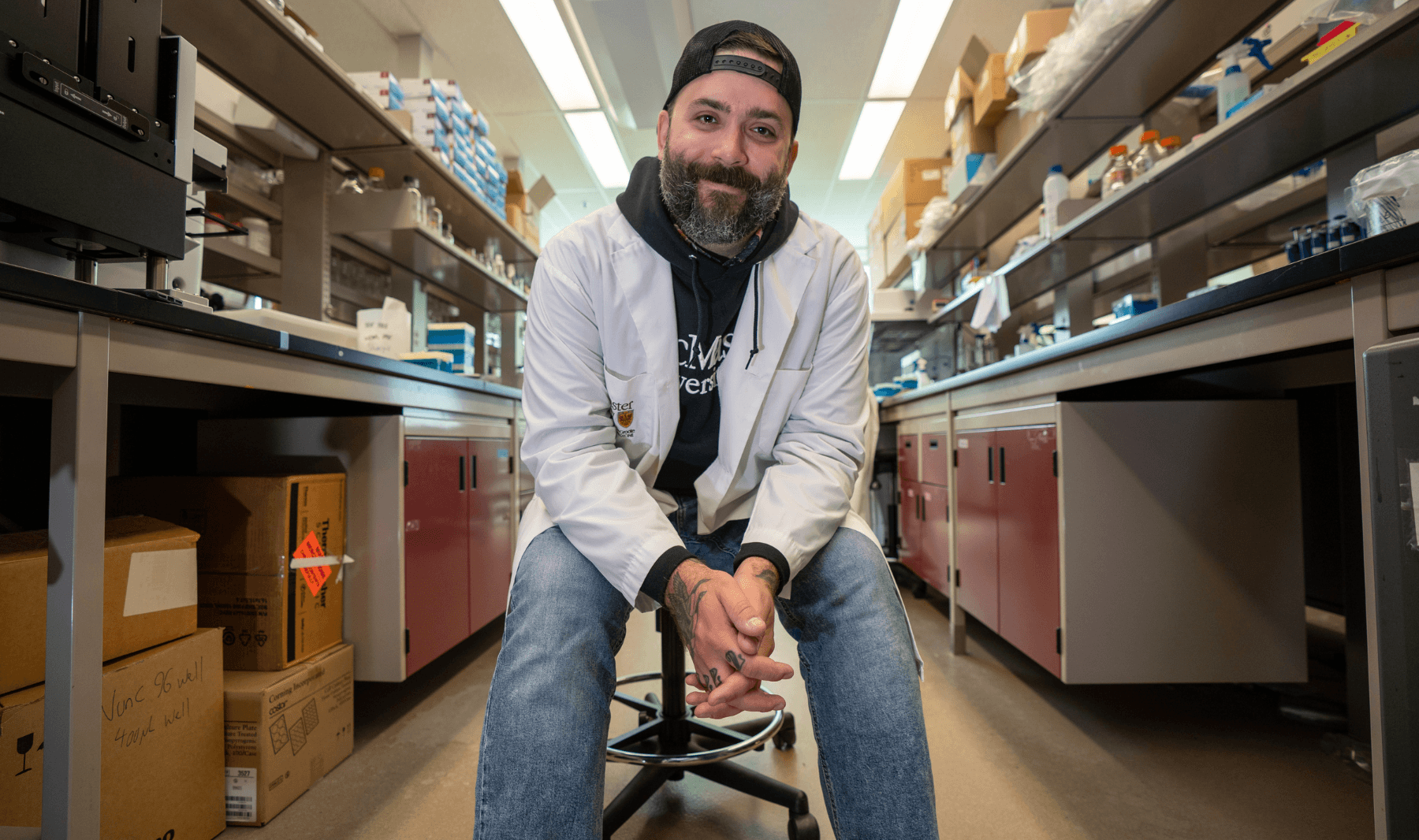
When Jon Stokes talks about his accomplishments, he rarely talks about himself.
He talks about the students in his lab. He talks about his colleagues. And he talks about Hamilton.
But now, one of Canada’s most prestigious awards programs is putting the spotlight back on him.
Stokes, a McMaster University scientist, entrepreneur, alumnus and founder, has been named one of Canada’s Top 40 Under 40® for 2026, a recognition that celebrates exceptional young leaders who are changing the way things are done in business, innovation and their communities.
“When I learned the news, I was over-the-moon excited. I couldn’t believe I was being given this honour,” he says. “But the happiness was short-lived because then I thought, if a group of people think I belong on this list, it’s my job not to let them down.”
An assistant professor in the Department of Biochemistry and Biomedical Sciences, the 36-year-old has earned international recognition for using artificial intelligence (AI) to discover new antibiotics and tackle antimicrobial resistance, one of the world’s most pressing public health threats. His research has attracted global attention, including recognition from The New York Times, which identified his work as one of the most significant scientific advances of 2023.
But while Stokes is helping redefine how new medicines are discovered, he’s equally focused on what happens after discovery.
As founder of the McMaster spinout company Stoked Bio, he is working to move promising therapies out of the laboratory and into the hands of patients who need them. It’s a vision that reflects a growing shift in academic health research: the idea that breakthroughs should not stop at publication but continue through innovation, commercialization and real-world application.
“Everything we do in the lab and in the company is about trying to discover and develop drugs to treat diseases that other people won’t — because it’s hard, and there are easier ways to make a huge return,” says Stokes, a member of the Michael G. DeGroote Institute for Infectious Disease Research.
Stokes is part of a new generation of researchers who are combining scientific excellence, AI, entrepreneurship and commercialization to accelerate discovery and create meaningful impact. And it is a powerful example of how McMaster researchers are translating ideas into therapies, companies and solutions that benefit patients, communities and the economy.
Across the university, researchers like Stokes are helping demonstrate what is possible when world-class science is paired with entrepreneurial ambition and a focus on solving real problems. At NexusHealth, for example, where Stokes is an executive member, researchers are accelerating the development of health innovations by bridging the gap between sectors.
And as a Heersink Distinguished Scholar of the DeGroote Heersink Hub, Stokes supports innovation and entrepreneurship education, helping students identify, develop, and commercialize research and ideas with real-world potential.
“At McMaster, we believe the most meaningful discoveries don’t end in the laboratory. We are focused on creating solutions that improve lives and strengthen communities. Jon’s work exemplifies that journey from idea to impact, combining world-class science with a relentless focus on addressing urgent health challenges,” says McMaster President Susan Tighe.
“I’m very pleased to see Jon receive this recognition. In the best McMaster tradition, his work pairs excellence with purpose, and translates discovery into meaningful impact. The fact that he’s one of our graduates makes it even better.”
For those who know Stokes, there is something fitting about a Hamilton-raised researcher — the son of two Stelco employees — receiving national recognition while building his career in the city where it began.
A self-described “McMaster lifer,” Stokes completed his undergraduate and graduate studies at the university, then returned to Hamilton to establish his own lab after a Banting Postdoctoral Fellowship at the Broad Institute of MIT and Harvard. He speaks openly about wanting not only to develop medicines that improve lives, but to create opportunities and economic growth in his hometown.
His journey, from local student to internationally recognized scientist and entrepreneur, reflects the role universities can play in fuelling innovation ecosystems, developing talent and generating solutions to global challenges. In many ways, it also mirrors Hamilton’s own evolution: a city built on industry that is increasingly forging its future through research, innovation and entrepreneurship.
That’s what makes Stokes’ recognition about more than one person’s success.
“I currently have 12 people in my lab who are building their own careers, and it’s up to me to be able to fund them, support them, and do whatever I can to make sure that they surpass me,” he says.
Stokes is the latest member of the McMaster community to be recognized by Canada’s Top 40 Under 40®, joining several notable alumni, faculty and graduates — including Tighe.
“Let’s talk about imposter syndrome for a second,” Stokes laughs. “Professor Susan Tighe, who’s the president of the university; Professor Brian Coombes, who’s my boss and the chair of my department; and Professor Emeritus John Valliant, a McMaster legend who just sold a two-and-a-half-billion-dollar company. It’s incredible company to be in, and I don’t think I’m as good as any of them.”
While Stokes’ trademark humility is as evident as his ambition, ask any of his peers and they’ll tell you he is right at home on that list.
Together, the McMaster laureates reflect the breadth of leadership emerging from the university, from business and entrepreneurship to health care, research and public service. Stokes’ inclusion underscores the university’s growing reputation as a place where discovery, innovation and commercialization come together to create meaningful impact.
Learn more about Jon Stokes
McMaster spin-out biotech company gets $2.5M in seed funding to develop critical medicines
McMaster-built AI model speeds up drug discovery, designs new antibiotic
Researchers discover new antibiotic for IBD — and AI correctly predicts how it works
McMaster researchers develop and share free antibiotic discovery tool to fight superbugs
Researchers invent artificial intelligence model to design new superbug-fighting antibiotics
Made at Mac: Scientist Jon Stokes heads new AI drug discovery startup
Scientists use AI to find promising new antibiotic to fight evasive hospital superbug
Home ice: Star researcher back at Mac to pioneer use of AI to fight antibiotic resistance