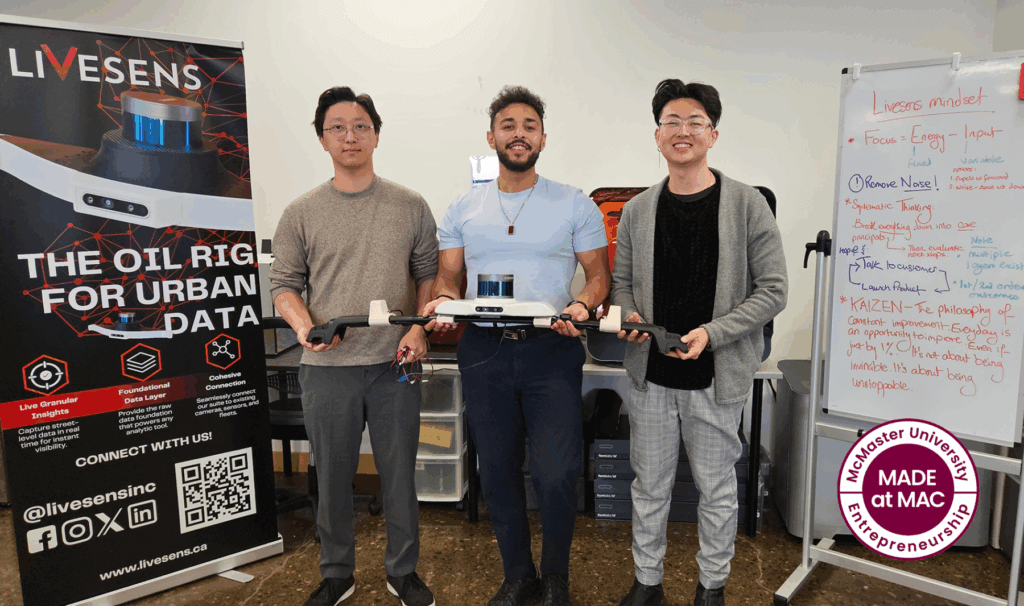
A McMaster-based startup is poised to drive the future of urban planning and development with mobile sensors that gather data on the world around us.
McMaster Engineering students Ali Hamdy, Jase Jin and Eddy Su launched LIVESENS — a combination of the words “live” and “census” — in 2024.
Their technology captures real-time data about environmental metrics, traffic patterns and pedestrian activity to inform decisions on a range of urban issues, including transit, infrastructure, economic investment and urban design.
We sat down with Hamdy to learn more about the company, which was one of the recipients of the 2025 McMaster Student Seed Fund. He and his co-founders will be taking part in the startup showcase at the Forge’s Startup Survivor Pitch Competition on Nov. 19.
What is LIVESENS? What was the inspiration for your startup and how did you get started?
LIVESENS is building the urban nervous system through a network of plug-and-play mobile sensors called Remora that are mounted on vehicles and continuously map urban environments in real time.
Each Remora fuses visual, environmental and structural data into verified real information about what’s actually happening — whether that’s a pothole on the road, a crowd forming, an intersection backing up, or changes in temperature and humidity.
My co-founders and I have always dreamed of a world that runs on live data; a place where cities could sense and respond to people in real time.
One night driving into Toronto, we saw huge billboards everywhere but discovered their viewership relied on outdated census data. As engineers, that sparked our curiosity.
We mounted taxi-top screens on our cars, added cameras for visual detection, and launched a small mobile ad network for local businesses. It worked, but we soon realized “views” were just the beginning.
That led to the development of our Remora sensors and interviewing customers to uncover new urban data use cases.
What are the main challenges you’re hoping to solve with this technology and who stands to benefit most from it?
Our technology solves critical challenges around fragmented and costly urban sensing by delivering high-granularity, multimodal data via everyday vehicles that are already driving around the urban landscape.
This tech benefits cities, transit agencies, startups and enterprises by powering safer, smarter decisions and optimizing city operations, while creating new revenue streams from assets already on the road.
Think Uber, for data.
We’re already acting on our vision and are partnering with several urban intelligence companies to map various parts of downtown Toronto, especially focusing on high-traffic corridors. This collaboration fine-tunes the types of data we collect and how we curate it to best suit real-world needs.
Just like in any startup, we’re constantly refining our sensor platform based on direct customer feedback. These partners all need targeted data sets directly from LIVESENS for their analytics and AI engines.
We’re creating a new way for humans to understand and interact with the world around us. The world stands to benefit from this.
How does LIVESENS work? How is the data that you’re collecting being stored and kept secure?
LIVESENS works by mounting small sensor units called Remora on vehicles that are already on the road. These units are equipped with cameras, special 3D mapping tools, and environmental monitors.
We use edge computing, where the device instantly blurs out faces and licence plates to protect privacy before sending any data. This means the data is cleaned and anonymized before it ever leaves Remora. This clean data is sent securely over fast 5G internet to a SOC2-compliant cloud system with strong security standards.
LIVESENS uses these Remora to transform everyday vehicles into a unified sensor network, helping cities and companies understand what’s really going on around them with a live, truthful view of what’s happening on the ground without compromising on privacy.
How has the entrepreneurial ecosystem here at McMaster supported the development of your startup?
We’re incredibly grateful to the Forge and McMaster’s innovation ecosystem for guiding us along the way. We joined the Forge’s Business Incubator program in January 2025 and have accelerated from idea to pilot-ready by leveraging mentorship, and academic expertise to refine our tech and business model.
Our journey has been fueled by collaboration, innovation and a bold vision.
The Forge staff have been key to our growth, helping us reach new heights and pushing us to do more every day.
Our lead mentors, Daryl Sherman and Eric Spearin, have expanded our minds to new possibilities.
All of you have made our growth inevitable. We also want to give a huge shoutout to the McMaster Student Seed Fund for providing us with resources along the way.
Where are you now with your company and what are your next steps? Where do you anticipate you’ll be within the next five years?
LIVESENS is a little over a year old. Over that time, we’ve interviewed hundreds of potential customers across multiple urban intelligence verticals, built and iterated multiple versions of our Remora sensor, and confirmed strong product-market fit with our first real customers.
We’re locking in strategic partnerships with heavyweight players like the City of Toronto, Ontario Centre of Innovation, Ontario Vehicle Innovation Network, Toronto Transit Commission, Rogers Communications, AWS, Predictif Solutions, and Natix Networks. Together we’re planting the seed of the urban nervous system.
With momentum building and all the pieces aligning, we’ve kicked off our first raise. This is when a startup officially asks external investors for money to grow the business. To reach this stage, a startup really needs to prove itself and show some real traction, so we’re really excited about hitting this milestone.
In five years, we aim to be Canada’s flagship urban data platform, powering cities across the nation and beyond.
Do you have any words of advice for aspiring entrepreneurs?
For aspiring entrepreneurs: Talk to your customers and iterate your product.
We have the mentality of “by any means possible.” This means everything from building community, connecting with people, and becoming a mentor to your peers. Through this cohesive ecosystem, everyone becomes drawn to your mission.
Move fast with clarity and grit. The world needs curious minds who are ready to execute. Build for a better tomorrow, and be that change.